
An official/source reference is linked below. Programme rules and registration windows can change.
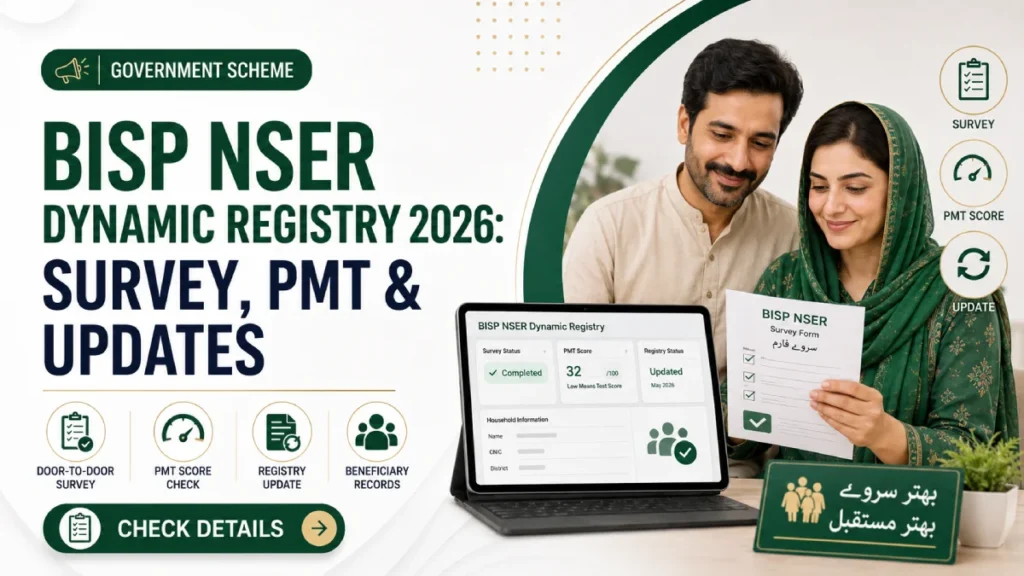
The National Socio-Economic Registry (NSER) is the household database BISP uses to identify and assess families for social-protection programmes. Instead of relying only on an old nationwide door-to-door survey, BISP now operates a Dynamic Registry model that allows households to register, correct information and update important changes through registration centres.
This matters because BISP eligibility is not decided by a simple online form. Household circumstances are recorded through the NSER survey and used to calculate a Proxy Means Test (PMT) score and other programme eligibility indicators.
What is the BISP Dynamic Registry?

Hi there 👋
Want Latest Government Jobs in Pakistan? Connect on Whatsapp
Just click on Start Chat button below
The Dynamic Registry is BISP’s system for keeping household data updated more regularly. BISP established registration desks and centres at Tehsil level so households do not have to wait several years for another nationwide door-to-door survey.
The system is designed to allow new registration, correction of missed information, household roster updates and periodic re-certification.
Who should visit a Dynamic Registration Centre?
The BISP registration-centre model is relevant to several types of households, including:
- Families that were missed in previous survey exercises.
- Households that need to update missing or incorrect CNIC information.
- Families with changes in household members.
- Existing beneficiaries asked to complete re-certification or re-survey.
- Households with discrepancies in earlier survey information.
- People affected by major household changes such as birth, death, marriage or disability status.
What information can be updated?
BISP’s Dynamic Registry framework includes multiple types of updates. Examples include:
- Missing household coverage or CNIC information.
- Resolution of discrepancies in the household record.
- Updating CNICs.
- Adding children after proper B-Form registration.
- Birth and death updates.
- Marital-status changes.
- Gender or disability-status updates linked with NADRA records.
- Periodic re-survey when household socio-economic circumstances need re-certification.
What is a PMT score?
The Proxy Means Test (PMT) score is a welfare score calculated from household socio-economic information collected through NSER. It is measured on a scale from 0 to 100.
BISP uses PMT thresholds when deciding Kafaalat eligibility. The currently published Kafaalat information states a PMT cut-off of 32, while families with a differently abled person have a published cut-off of 37.
A person cannot legally choose or buy a PMT score. The score is generated from the household data and programme rules.
Does a low PMT score automatically guarantee every BISP benefit?
No. Different BISP programmes can have additional conditions. For example, Taleemi Wazaif requires child enrollment and attendance, Nashonuma has health and age conditions, and Hunarmand has education and age requirements.
NSER is the household eligibility foundation, but each programme can apply its own rules.
How to register or update your household
BISP registration is handled through its registration centres/Tehsil Offices and related Dynamic Registry facilities.
- Identify the nearest BISP Tehsil Office or Dynamic Registration Centre.
- Take the original CNIC of the relevant adult household member.
- Take NADRA documents for household members where applicable, including B-Forms for children.
- Provide correct household, income, education, employment, disability, housing and asset information during the survey.
- Review information carefully before the survey is finalised.
- Keep the mobile number used for BISP communication active.
- Use 8171 for official BISP SMS/status communication.
What information does NSER collect?
BISP’s published registry information shows that the survey covers a wide range of household indicators, including:
- Education and school attendance.
- Employment and workforce information.
- Disability and health-related profiling.
- Household structure and living conditions.
- Electricity, gas and water access.
- Housing type and sanitation.
- Agricultural land ownership.
- Livestock ownership.
- Household assets and access to technology.
This is why the survey cannot be reduced to one question about income.
Is there an online form for complete NSER registration?
BISP provides online portals for status checks and related services, but the household Dynamic Registry survey itself is carried out through BISP’s registration system and centres. A website asking for money to “complete your NSER survey online” should be treated with suspicion.
Is the BISP survey free?
Yes. BISP has repeatedly stated that registration/survey services are free. There is no legitimate survey fee for adding a deserving household to the Dynamic Registry.
Do not pay a person who claims they can reduce your PMT score, make you eligible or speed up approval.
What happens after the survey?
Survey completion does not immediately mean a family has been approved for Kafaalat. The household information is processed and assessed under BISP’s eligibility rules.
Families can use official BISP channels, including 8171, to check status once records have been processed.
What is re-certification?
BISP periodically asks existing beneficiary families to update their socio-economic information. This allows the programme to check whether the household still falls within the relevant eligibility criteria.
A beneficiary who receives an official re-survey/re-certification instruction should complete it within the required programme process. Ignoring a legitimate update request can affect continued eligibility.
What documents should you carry?
The exact case determines which documents are needed, but families should generally keep:
- Original CNICs of adults concerned in the update.
- NADRA B-Forms/CRCs for children.
- Documents supporting disability status where relevant.
- Family information required to explain births, deaths or marital changes.
- An active mobile number for programme communication.
How to avoid NSER fraud
- Do not pay for the BISP survey.
- Do not hand original CNICs to an unauthorised agent.
- Do not believe anyone who promises a specific PMT score.
- Use BISP Tehsil Offices/registration centres for household changes.
- Treat 8171 as BISP’s official SMS number.
Official links
Common questions
Can I pay someone to lower my PMT score?
No. PMT is calculated from verified household information. Anyone offering to sell a lower score is not using a legitimate BISP process.
Where can a missed family register?
BISP uses Tehsil-level registration centres and Dynamic Registry facilities for missed households and updates.
Is survey completion the same as Kafaalat approval?
No. The household is assessed after registration under BISP’s eligibility rules.
Can household changes be updated later?
Yes. Dynamic Registry is specifically intended to support regular household and roster updates.
Check the latest eligibility, deadline, payment or application instructions on the relevant authority or organisation website. PakGovSchemes.org.pk is an independent information website and does not accept government or employer applications.
