
An official/source reference is linked below. Programme rules and registration windows can change.
The Punjab Agriculture Department has listed a major new farm-mechanisation initiative for 2026-27 under the Punjab Climate Resilient and Low Carbon Agriculture Mechanization Project (P-CLAMP). The project is designed to help farmers and agricultural service providers obtain modern machinery through a combination of government matching grant, applicant equity and bank financing.
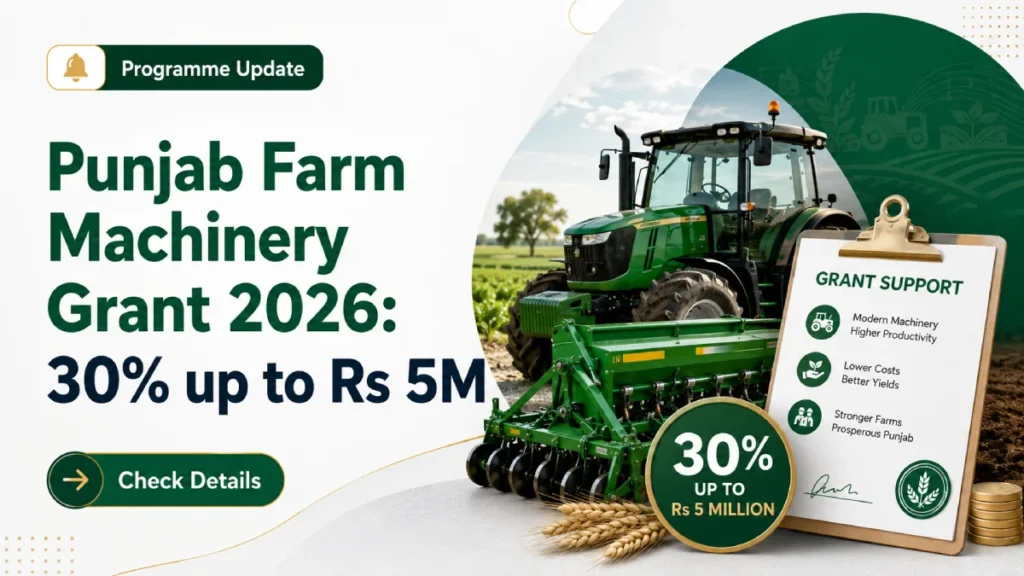
The published financing model is significant: the government plans a 30% matching grant per eligible machine, up to a maximum grant of Rs 5 million per machine. The farmer or service provider contributes 20% equity, while banks are expected to finance the remaining 50%.
How the financing structure works

Hi there 👋
Want Latest Government Jobs in Pakistan? Connect on Whatsapp
Just click on Start Chat button below
The Agriculture Department’s 2026-27 new-schemes page publishes this structure:
- Government matching grant: 30% of eligible machine cost.
- Maximum government grant: Rs 5 million per machine.
- Farmer/service-provider equity: 20%.
- Bank financing: 50%.
This is not a 100% free-machine scheme. An applicant must be able to arrange the required equity and satisfy the bank-financing process for the financed portion.
Example of how the cost sharing may work
Suppose an eligible machine costs Rs 10 million and the full 30% grant applies:
- Government grant could cover Rs 3 million.
- Applicant equity at 20% would be Rs 2 million.
- Bank financing at 50% would be Rs 5 million.
If an eligible machine is expensive enough that 30% would exceed Rs 5 million, the published maximum grant cap means the government portion would not exceed Rs 5 million per machine.
Who is the project intended for?
The project refers to both farmers and agricultural service providers. This is important because some high-cost farm machines are more practical as service businesses that serve multiple farms rather than being purchased by a small individual farm for occasional use.
The final applicant criteria, landholding requirement, bank standards and machine-specific conditions should be taken from the programme’s detailed application notice when registration opens.
Which machines are included in the project targets?
The current Punjab new-schemes page lists several categories of modern machinery and overall project targets:
- Head / Half-Feed Rice Combine Harvesters: 3,050 units.
- Full-Feed Rice-Wheat Combine Harvesters: 1,052 units.
- Rice Transplanters – Riding Type: 800 units.
- Rice Transplanters – Walk-Behind: 4,000 units.
- Rice Nursery Raising Machines: 1,506 units.
- Balers for Crop Residue Management: 450 units.
The published list shows a strong focus on rice mechanisation and crop-residue management.
Why is crop-residue machinery included?
Punjab faces recurring air-quality and residue-management challenges after major crop harvests. Balers and other residue-management machinery can help turn crop waste into a usable resource instead of relying on open-field burning.
The project therefore links mechanisation with lower-carbon and climate-resilient agriculture rather than only increasing tractor horsepower.
What is the overall scale of P-CLAMP?
The Agriculture Department lists the total project cost at approximately Rs 36.12 billion, with a 2026-27 allocation of about Rs 3.4 billion.
The project period runs from 2025-26 to 2030-31, so all machines are not expected to be distributed in a single year.
Is the application portal open?
The Agriculture Department’s current public new-schemes page provides the financing model, machine categories and overall targets. It does not, on the page reviewed for this update, provide a general public application portal for farmers.
Farmers should therefore treat this as an official programme-information update and wait for the Agriculture Department’s application/selection announcement rather than submitting information to an unofficial “registration” website.
What should interested farmers prepare?
Because bank financing is built into the model, applicants should prepare for more financial verification than a simple cash-subsidy programme.
- Valid CNIC and active contact details.
- Farm or agricultural service-business information.
- Landholding/operational details where required.
- Ability to provide the applicant’s 20% equity portion.
- Banking and credit information required for the 50% financed portion.
- A clear need/business case for the selected machine.
Who may benefit most from the scheme?
The programme may be particularly relevant to:
- Commercial farmers who need specialised rice machinery.
- Farm-service providers who rent machinery services to multiple growers.
- Entrepreneurs providing harvesting, transplanting or residue-management services.
- Farmer groups/cooperative-style service operations if allowed under the final programme rules.
The final notice will determine which applicant structures are formally eligible.
How is this different from the Green Tractor Programme?
The Green Tractor Programme focuses on subsidised tractors with published tractor horsepower and landholding thresholds. P-CLAMP is broader and targets specialised mechanisation such as combine harvesters, transplanters, nursery machines and balers.
Its cost-sharing model also includes a bank-finance component, while Green Tractor phases publish a fixed subsidy amount per tractor.
Important precautions
- Do not pay a private agent for “early registration”.
- Do not assume every agricultural machine qualifies; use the official eligible list when released.
- Remember that the 30% grant is capped at Rs 5 million per machine.
- Plan for 20% equity and bank assessment for the remaining financed portion.
- Check the Agriculture Department’s official pages for phase-specific application dates.
Official links
Common questions
Is the government paying 30% of every machine without a limit?
No. The published grant is 30% per machine with a maximum government grant of Rs 5 million per machine.
How much does the applicant contribute?
The published model requires 20% farmer/service-provider equity.
How much comes from a bank?
The project page states that banks will provide 50% loans.
Can farmers apply online now?
The programme-information page reviewed for this update does not provide a public registration portal. Applicants should wait for the official application announcement.
Check the latest eligibility, deadline, payment or application instructions on the relevant authority or organisation website. PakGovSchemes.org.pk is an independent information website and does not accept government or employer applications.
